 by
by By: Skye Suess
Originating from a song by rapper Skrilla, the “67” meme has grown rapidly online. It became popular in featuring edits of professional basketball players, including LaMelo Ball, who is 6 feet 7 inches tall. It started as a trend like any other, but quickly expanded from TikTok and into everyday life.
What was first known as a viral joke has turned multi-generational, with elementary and middle school aged children reacting loudly when the numbers are mentioned. This arises concerns about a new era of “meme literacy,” with teachers and parents worried that this new craze reflects just how chronically online Generation Alpha is. An increase in screen time in young children has produced long term effects in reading comprehention, ability to focus, and attention span. With early access to constant stimulation on screens, students have become completely uninterested in reading. The pandemic also limited meaningful text exploration in schools, with students failing to read at home and instead scrolling online, they have missed crucial language exposure and therefore have no interest in picking up a book.
Suprising concerns in Gen Alpha’s social media use include statistics of: over 50% of children use social media before the age of 12, 73% of parents are concered about their child’s social media use, 40% of children own their first smartphone by around age 10, and the average age of first exposure to social media is in early childhood.
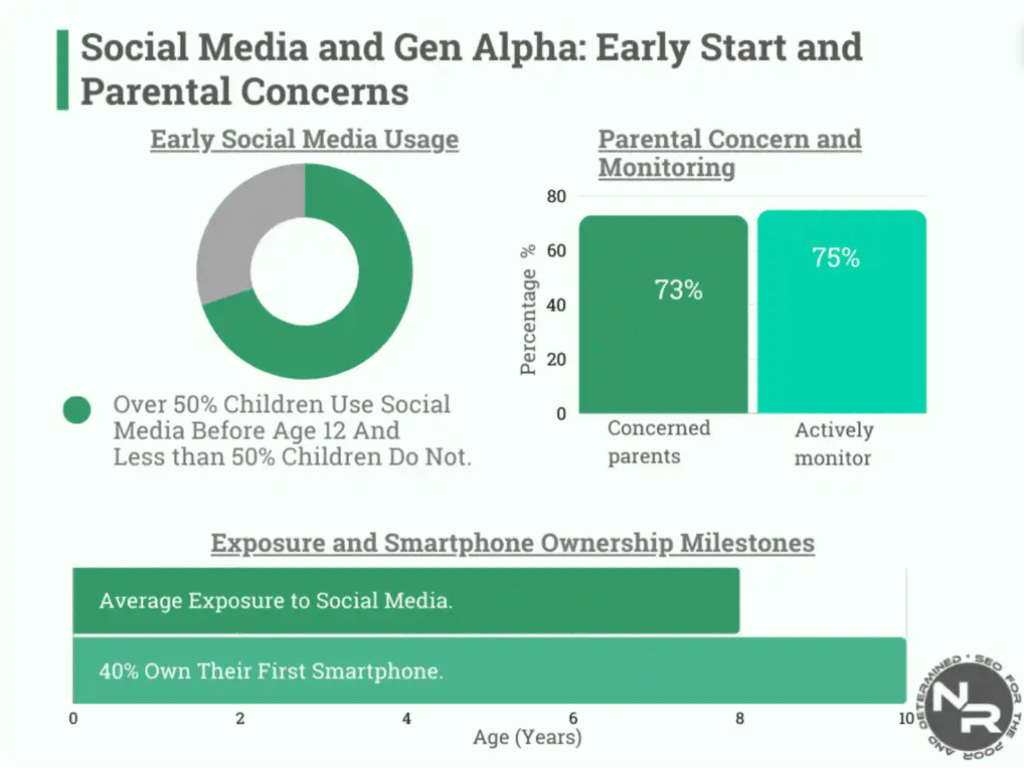
Gen Alpha Social Media Statistics 2025: Engagement, Platforms, and Behavior
According to an article titled, The Suprising Reason Kids Can’t Seem To Read Anymore, “children’s daily screen time increased by 17% during the pandemic, with 8- to 12-year-olds averaging four to six hours daily…. When you pair the technology increase in schools with the number of hours spent at home on iPads, smartphones and other devices, the risk is that future generations will simply be unable to think as deeply and with as much complexity as in the past.”
We are now in an era where “being online” doesn’t end when you put down your phone. This is seen in children’s technology use as well as parents unable to disconnect from their work tasks, when bosses are still able to message employees even after they have clocked-out. It has created a disruption in the way our brains work, with a constant need to be connected to our devices and fear of “missing out” when unable to scroll.
Some argue that memes like “67” promote a performance illiteracy where humour is rewarded as entertainment. Students have began acting out online culture in real life. Although sometimes lighthearted in a way to connect with others, it has become a new language of “brainrot.” Disruptivity in classrooms is taken to a new level, where everyone reacts the same in “knowing” popular memes to avoid being singled out. Teachers have taken action to “ban” the slang but sixth-grade teacher Adria Laplander, explains how it only makes them “want to push buttons.”
The “67” meme may seem like a silly phenomenon, but it reveals information in digital culture and how younger generations communicate with each other. Social media is continuing to blur the lines of what is behind your screen and what is real life. Although it can be used positively, we question if digital society and traditional learning can coexist? or do memes speak louder than words?
To read more, connect with me on Linkedin.



Hi Skye!
I love that you decided to write about this topic in your blog! I agree that the rise of meme culture among Gen Alpha reflects a growing dependence on online stimulation that impacts focus and literacy. It’s interesting, and concerning, how humor and virality now shape social interaction and learning more than traditional reading or play. Overall, this was such a interesting blog post to read, great job!
Hi Skye, I think this topic is really important to look at on a broader scale. I feel like social media is starting to shape our society in a way where we humorize everything, even things that don’t make much sense, like going “6/7.” I think it’s crazy that this was voted word of the year, and honestly, it makes me worried for future generations.
Hi Skye, I love that you talked about this, and it immediately caught my attention compared to some of the other titles (so great job!). For this generation, I think this is a recurring thing with other memes, such as “skibbidi toilet. ” But when I think back to our day, we were so into lingo such as “21,” “bruh” or “what are those,” and they eventually died down. I think the same will happen for the future generation. At least I hope so.
Hi Skye! This was a great topic to choose and instantly grabbed my attention. As someone who consumes a large amount of media, I had never thought about this meme and phenomenon this way. I have a brother who is 10 years younger than I am, so when we were both explaining this joke to our parents, we took very different approaches. I explained it was like us saying “ur mom”. It has no meaning, but for a generation when that was the response to a question, we would all laugh. For this generation, it seems very different because of COVID and the huge access to media at such a young age. I think this will be something that is largely talked about in the future. I really enjoyed this!
Hi Skye!
I found your post on the “67” meme a great read! Meme culture is so interesting in how quickly humor can rise and fall, and the way certain ideas catch on feels almost unpredictable. I love how you highlighted how memes can become a sort of language, shaping how younger generations communicate and react in real life. It’s wild to think about what dictates what becomes a meme and how something seemingly small can spread so widely and influence culture.